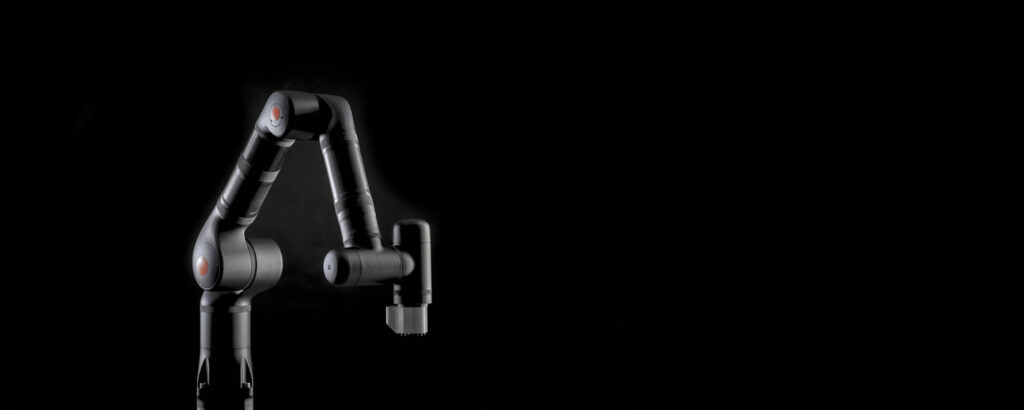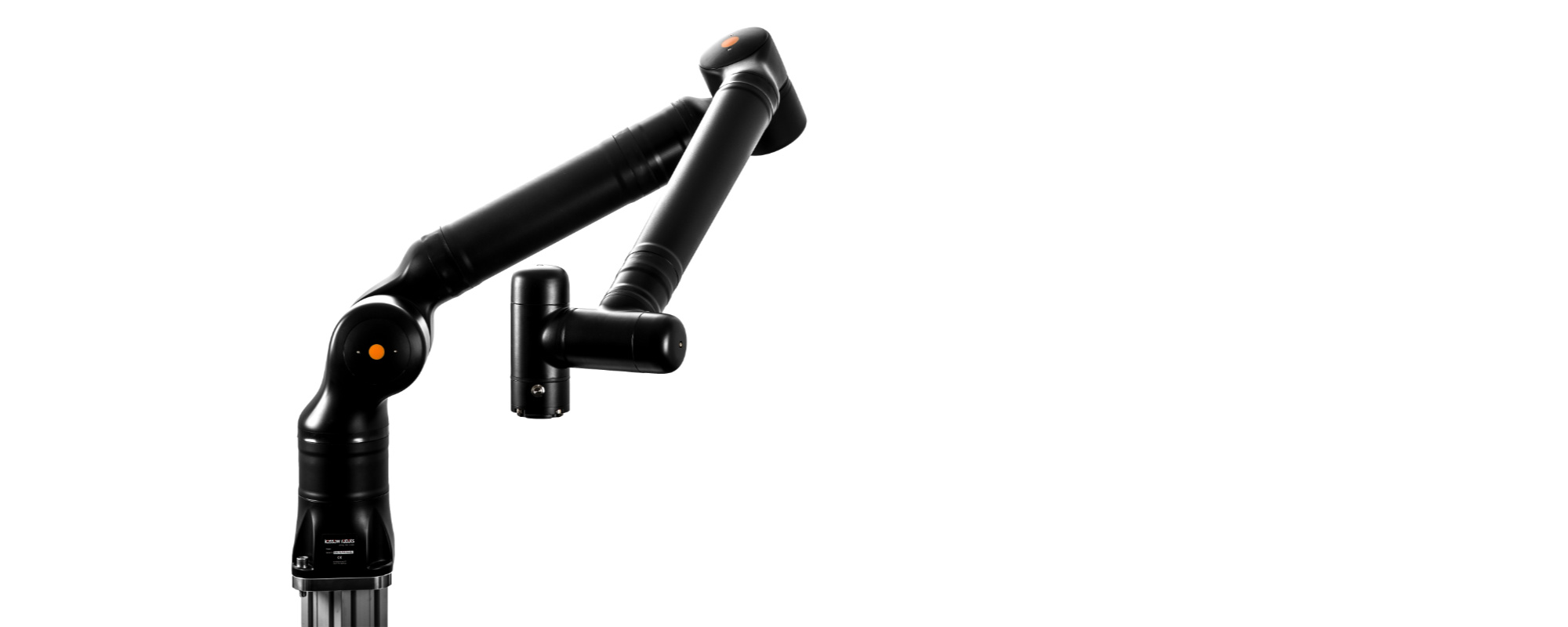
The collaborative robot market is dominated by six-axis robots, or six-degree-of-freedom (DoF) robots, as they might otherwise be called. Representatives of this group include Universal Robots, Doosan, Auba, Hanwha, Omron TM, Techman Robot, or others. A generational leap ahead of them are cobots, which have seven degrees of freedom. Exactly as many as a human arm. Sounds good, but what does this mean in practice for production efficiency?
What gives the seventh degree of freedom?
Flexibility and reach effective in the application.
The 7th axis allows the robot to be positioned even in narrow spaces between other equipment. This is important for efficient use of space, as it does not require an increase in plant area or costly reorganization.
The 7-axis cobot can reach the work area from around a corner. This allows it to work from a position offset to the side of the work area. This is important for the technician, among others, leaving him free to access the work area. With the cobot off, the technician is free to rearm or clean the machine or do something on the machine without using the cobot. In an analogous situation, the arm of a 6-axis cobot would have to be removed along with its work table.
We can distinguish a number of applications (smaller machine models from manufacturers such as: Haas, Mazak, Doosan, Okuma or DMG Mori) where, in terms of effective reach, a 7-axis Kassow Robot with an arm reach of 850mm can comfortably compete with larger 6-axis robots with a reach of more than 300mm. Simply put: a shorter but more agile 7-axis robot arm can do the same thing as a larger (and often more expensive) 6-axis Kassow Robot model.
Here – a 7-axis cobot works from behind a corner (leaving space for the operator – if needed), simulating human work.
More possible applications.
The 7th axis allows for more applications. This is partly related to flexibility, but not only. Key here is the additional movement axis, just after the 3rd joint, which allows the tool path (end effector) to be maintained. This allows, among other things, to spread paint, glue, or other surface treatment over a larger area, as well as to reach hard-to-reach nooks and crannies.
Additional movement on the 3rd joint also allows us to safely handle delicate objects, or those whose orientation in space cannot be changed during movement. This is because the 7th axis gives us the possibility to keep the vector of the tool or the held object within a much larger range – limited only by the length of the individual parts of the arm.
Safety
Increased safety can be considered in three approaches, where each is closely related to the previously mentioned capabilities of the 7-axis cobot.
At this point, we want to point out that the safety of people working with a collaborative robot can only be considered for the overall application it is used for.
First of all, the robot’s movements can be programmed in such a way that the object or tool being moved can only remain in an orientation that is safe for humans. For example, by turning them away from people with sharp edges, or so that the tool does not leave the safe zone (according to the ISO/TS 15066 technical specification), which is the height from waist up to shoulder height.
Second, and related to the point earlier, a cobot with seven axes can by itself shield the tool or object being carried from people.
The third aspect is the issue of locating the 7-axis cobot in the company of other machines. On the one hand, this allows more space available for workers, and on the other, reduces the number of places of possible collision and physical access to the robot.
Why is this solution so uncommon?
Building a robot with a 7-degree-of-freedom arm is not that easy, as evidenced by the rarity of this type of solution. The challenges this standard presents to engineers are software and mechanical.
The second aspect is mechanical challenges. These consist of the ability to transfer drive to all joints, with a force and speed that ensures safety on the one hand, efficiency on the other, and that the overall mechanism can withstand the loads and operating temperatures.
7th axle vs. software.
Adding another degree of freedom, which must be taken into account by the computer to determine the optimal path of the tool – TCP, is quite a challenge, because the number of combinations grows exponentially. The second software aspect is the proper simulation of the physical model, which is later used to – on the one hand – make the machine move properly, and on the other hand – compared with real-world overload readings, which is a guarantee of safety.
7th axis vs. mechanics.
The mechanical challenges of the 7th axis consist of the ability to transmit drive to all joints with a force and speed that ensures safety and at the same time efficiency. In addition, so that the entire mechanism is able to withstand loads, operating temperatures and guarantee the rigidity of the structure and precision of movements.
Kassow Robots sets its sights on the next generation
The seven-axis solution has been successfully implemented in Kassow Robots’ collaborative robots.
The company’s founder, as well as its chief designer, Kristian Kassow has created a robot with powerful drives, with software that allows the entire systems to be managed intuitively and safely.
Kassow Robots‘ ease of use, as well as its application capabilities, is a generational leap over other brands.