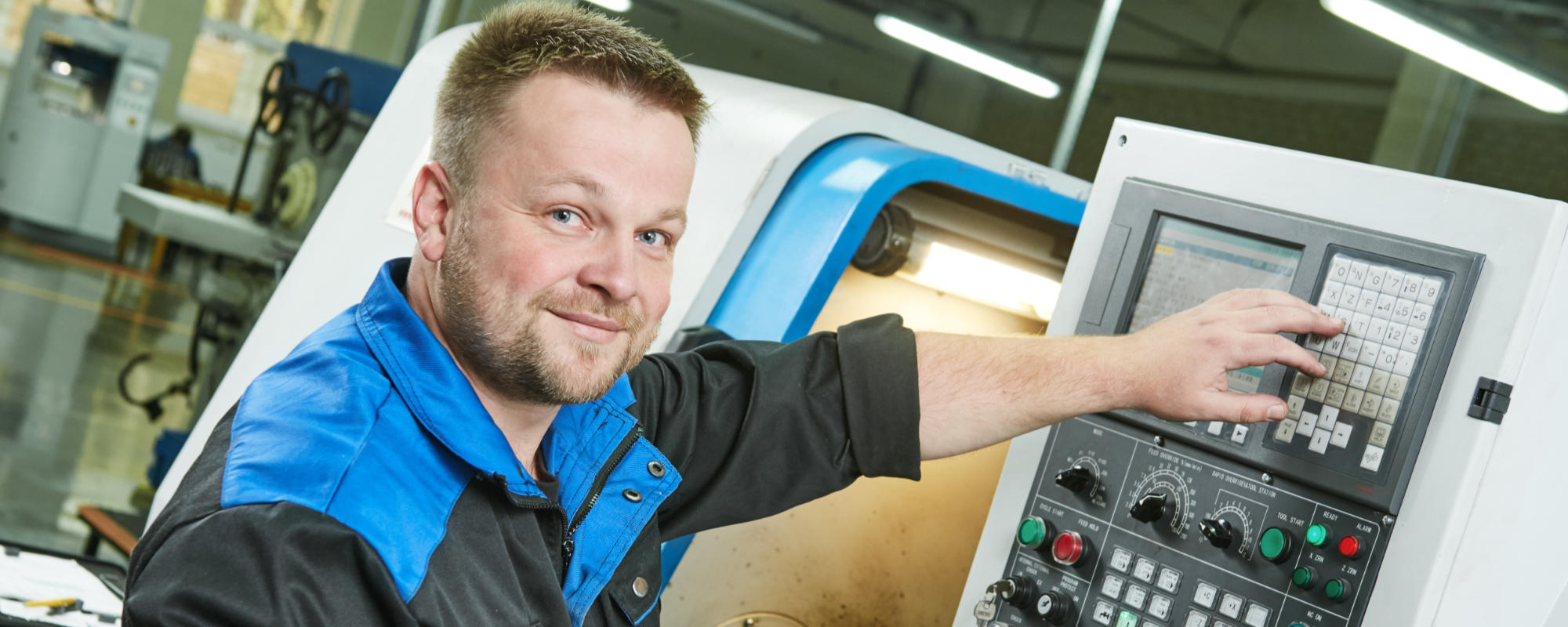
When visiting manufacturing plants, I have the opportunity to meet people from many backgrounds, industries, working in different positions. Their needs and opinions on robotization and the use of cobots naturally differ. You could say “every person is a different story,” and I listen to each of them with curiosity. Among these companies, machining facilities hold a special place in my heart. I worked many hours programming and operating milling machines and numerical lathes. The cut hands and fingers, the shavings in my hair, the disgusted look on my wife’s face when I come home all soaked with the smell of coolant… ehh, priceless!
Some of the people I meet in manufacturing plants are distrustful of robotization of the CNC machine workstation. They can’t imagine how a dumb robot (yes, robots are dumb – they only do what you tell them to do) can replace an operator. In addition to loading and unloading parts, after all, a human being measures components, corrects offsets and generally keeps a close eye on everything that happens during machining.
The thing is that the robotization of the operation of such a position is a process. Such a process is best done gradually, and the biggest role in this transformation is played by our hero – the Operator.
Fundamentals of Successful Automation
The transition from CNC machine operation by an operator to operation by a cobot is best accomplished in a few steps. A successful automation process starts with understanding the process (understanding is the key word) and changing to control (also the key word) the machining process. This can be accomplished by planning the steps rather than merely reacting to changes and deviations that operators observe.
Automation can be introduced when we understand how long a machine can run before requiring human intervention. We will then put in place a schedule that ensures that the operator performs the necessary actions to guarantee a successful machining process.
At the beginning of automation implementation, a human is necessary to supervise and correct the entire process. We use this time to catch any possible errors that may occur when we finally leave the robot alone with the machine.
Once the machining process is well understood, improved and controlled, a robotic CNC workstation can run for 24 hours or more without intervention.
Below you will find 4 steps that will guide you to successful CNC automation.
STEP 1 – What the job currently looks like
Start by assessing how operators currently ensure the success of the production process. What activities do they do and how often do they do them to keep the components produced on spec and the machine in great shape? The most common activities are:
- measuring components,
- correcting tool wear offsets,
- removing chips from parts, fixtures and table,
- replenishing coolant,
- cleaning the coolant tank and filters.
STEP 2 – Create a schedule to maintain and control the process
Along with understanding what activities operators perform to keep production correct, start measuring how often they perform them. Based on this, prepare a schedule that will ensure that all these activities are performed on a regular basis, and not just based on intuition or as a response to failures.
Typically, the initial production control schedule includes:
- inspection of components made,
- inspection of tool wear and replacement,
- chip removal,
- emptying of chip containers,
- monitoring the level and concentration of coolant.
I realize that in an ever-changing production environment, the most difficult part will be managing the tool life cycle. Constantly changing component orders require different tools each time … but are they really? People very often underestimate and fail to apply a very simple principle of effective manufacturing – STANDARIZATION.
By standardizing cutting tool suppliers and reducing the number of tools, we are able to easily reduce our “headache” in the realm of predicting how long a particular tool will last. When the number of tools we rely on is quantifiable, then it will be easier for us to predict their wear and tear and the need for replacement.
Electronic gadgets also come to the rescue, such as contact probes for measuring tools and built-in options in the controller for managing the inventory of tools in the machine tool magazine.
Personally, I often use both methods successfully. On our Haas machining center, it is easy to set the Max Spindle Load, which is the maximum allowable spindle load. First we observe on a new tool at what load it will break. We set the allowable load at 75-80% of this value. When the machine tool senses that the value has been exceeded, an alarm pops up and operator intervention is required.
To get small diameter tools under control, we add a few lines of code to the machining cycle, which, at each tool change, will perform a tool probe measurement cycle and check whether the tool is broken.
With such techniques, we drastically minimize the risk of avalanche damage to subsequent tools, production of defective components and damage to the machine.
STEP 3 – Introducing process automation
Key elements to pay attention to at this stage:
- Follow the robotic system manufacturer’s or integrator’s guidelines for kit mounting, communication with the CNC machine and the process itself.
- Focus on simplicity and reliability in automating the process instead of speed.
- Start by closely monitoring your robotic machine operation. Carefully analyze any failures and try to find the cause so you can make the required adjustments and changes.
- If possible, try to use spindle probes and tool setting probes. Remember that with frequent measurements you will ensure the reliability of your machining and minimize possible errors.
At this point, I would like to emphasize the importance of simplicity and reliability of robotic operation of CNC machines. When introducing such a solution at your company, start with simple things. Program your first automation for workpieces for only one operation. Based on this, make sure the workpieces are loaded and unloaded correctly every time. Work at a limited speed and pay attention to whether the process is repeatable. Pay special attention to where chips accumulate and how they affect the clamping of workpieces.
STEP 4 – Expanding automation and improving CNC control schedule
As you gain experience and eliminate all potential problems, try adding a second operation on the same workpiece to the process. Think about how, in an easy and efficient way, to rotate the workpiece and move it from one vise to another. You may need a second gripper to match the shape of the workpiece after the first operation, or you can use electric grippers. Adaptive electric grippers such as OnRobot or Robotiq can easily be programmed for any size workpiece and can be adapted to any shape.
Use all the ways available to you to automatically remove accumulated chips on the machine table and vices. Flushing workpieces with coolant, using a compressed air nozzle or the Lang Clean-Tech cleaning chuck are all proven methods.
The tasks and goals you need to achieve are:
- Increase process reliability and extend the required operator interventions over time.
- Chip control: observe where chips occur and level their accumulation.
- Preventive tool management: measure tool life and use this data to have the tool inspected or replaced at the right time.
- Schedule CNC machine maintenance that includes: maintaining coolant and oil levels, changing filters, thoroughly cleaning the table, vices, chucks, spindle, and regularly checking the accuracy of your machine.
- Move toward understanding, measuring and controlling the entire process to produce components that fully meet specifications.
Process reliability is the key to success!
Use all possible tools you have in your arsenal to ensure trouble-free operation of your robotic station. In return, you’ll get unmanned production and often an extra night shift.