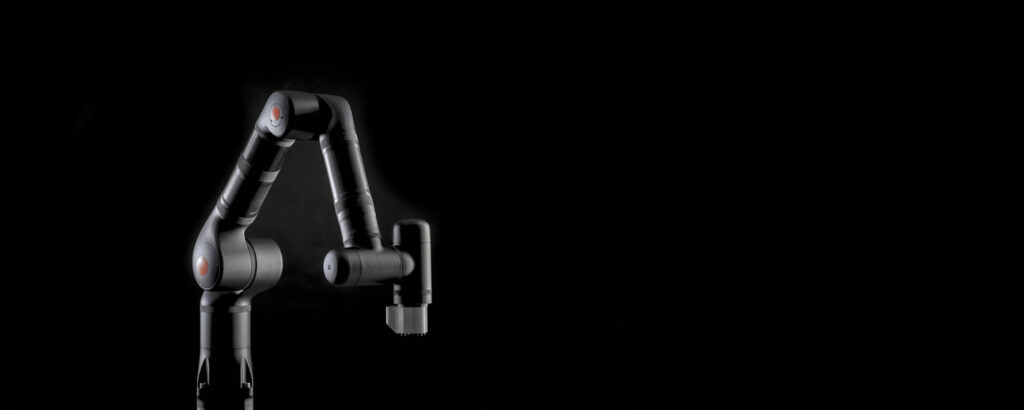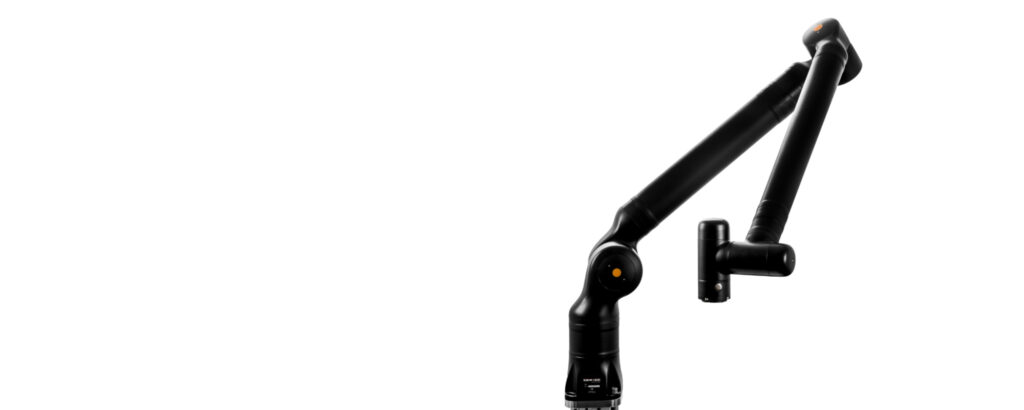
Will robots replace humans? Will they take away jobs? Looking through the press and portals dedicated to technologies of the future, one can get the impression that, lo and behold, soon we will all be replaced by intelligent machines, automation processes, or artificial intelligence. Industrial robots are leading the way in this defeatism, followed closely by collaborative robots. The latter are bringing the possibility of automation to micro and small businesses as well, and will soon overtake their larger industrial brethren in terms of scope of implementation.
How much truth in this?
As shown not only by statistics, but also by situations we are confronted with almost every day, Polish business is confronted with two phenomena: a chronic shortage of labor and low labor productivity (productivity growth is lower than wage growth). Obviously, this translates into problems with competitiveness, limited productivity of businesses and spends sleepless nights for owners, especially small and medium-sized companies.
And this is where the cobots come in, all in the black!
The remedy for Polish companies, both in terms of increasing capacity, lowering costs, solving the shortage of workers, which can be painlessly implemented are collaborative robots. The size of the enterprise does not matter. Are we talking about replacing people, at a time when these people are in short supply? By no means, we are talking about supplementing them – giving them new tools.
Almost every entrepreneur will confirm that the people for the job are simply not there. What is left is either to patiently look for someone to fill the position, or to divide the duties among the current team. This strongly affects efficiency (and the employee chooses the duties that are most convenient for him or her), thus creating bottlenecks.
Imagine a situation where there are two machine stations per employee in a plant that require constant maintenance. Obviously, one of the workstations stands idle or its productivity is very low. The situation can change if this worker operates two cobots (programming them, delivering the material and picking up the finished goods), and only the cobots operate the machines. In this case, the increase in efficiency is obvious: production increases and fixed costs in sales decrease, which naturally translates into an increase in competitiveness (the ability to offer lower prices).
Reminding yourself that a collaborative robot can work almost continuously, in three shifts, at a constant rate, you can make this calculation even more profitable. A level (even) higher, of course, is to optimize the processes themselves by applying various methodologies, such as Lean Robotics.
Interestingly, as a study conducted by MIT in 2016 based on observations at BMW plants shows, in most situations, creating an application based on a human-robotic team yields 85% better efficiency than in purely robotic or entirely human-operated applications.
From the employees’ point of view
Implementing collaborative robots into a company is first and foremost about freeing production workers from the most routine, repetitive, tedious, boring, and therefore disliked tasks, to work that is more mentally or manually demanding, more creative, or requires critical thinking. This is the creation of new activities involving handling and programming cobots, adapting them to new tasks.
Secondly, cobots in the company increase job security by increasing the company’s own skills and enabling the company to increase its efficiency, thus increasing its competitiveness and ultimately global production (sales) and business profitability.
Summary
The implementation of collaborative robots in enterprises is not only a foreseeable future lack of risks for employees (on the contrary), but also the possibility of a leap in labor productivity and efficiency (profitability) of the entire plant.