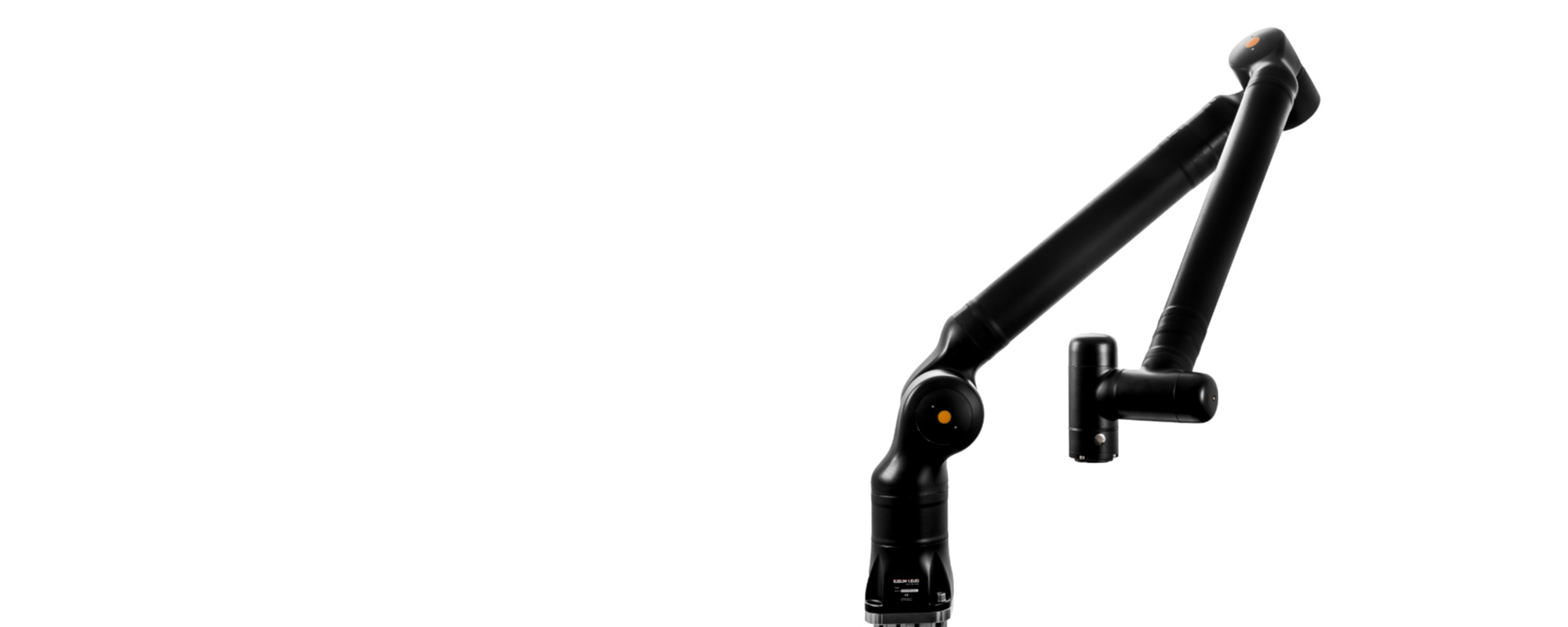
Collaborative robot or cobot are all interchangeable names for one, but all the time growing family of robots, not only with industrial applications. In this article we will focus on defining this category of devices looking from a technical-normative point of view.
Collaborative robot is a category introduced by the ISO/TS 15066 specification talking about cooperation between robots and humans in a workspace. The standard introduces 4 modes (variants) of such collaboration. In this article, we will focus on force limited robots – which are just one of the modes, and appropriating the name of the whole category, as well as colloquial terms – cobots.
For more on other modes of robot-human collaboration, see robotiq’s article, “Robotics. “What Does Collaborative Robot Mean?”.
So what are force-limited robots?
Collaborative robots that fall into this category are all about advanced safety features. At their core are built-in torque force sensors that watch over every movement of the device’s arm. As soon as they detect an unplanned overload (which most often means a collision), they immediately stop the work. This causes the robots to “feel” that something has gotten in their way. This feature, combined with the limited speed of operation (in this mode), as well as specially designed rounded shapes with no possible jamming points, allows such a robotic arm to work in close proximity to people.
Any collaborative robot must also be able to implement additional safety functions, i.e. connecting additional sensors, designating safety zones or limited speed by software.
Of course, a collaborative robot alone does not guarantee safety. What needs to be considered is the specific application (i.e.: what the cobot does, what tools it uses, how fast it works, how organized the workstation is, etc.), which must pass a risk assessment.
What else makes a robot collaborative (besides safety functions)?
First is the ease of integration into the plant infrastructure. This is true for both developed industrial organisms and small businesses that are just entering the world of automation. In the case of the latter, the cobot can become the center of automation, into which more machines will be plugged, and it is the cobot’s program that will control them.
Second (but what follows partly from the first) is easy-to-use and intuitive software. The idea is simple – to make it possible to “program” the robot without programming. It boils down to putting together a program based on predefined commands, from which (on the principle of building blocks) the whole program is composed. The commands here include not only the arm itself, but can flow to surrounding (connected) devices, such as CNC machine tools, conveyor belts; as well as be received from external systems and influence the operation (e.g., input specific variable values).
The best-known brands of collaborative robots besides Kassow Robots are: Universal Robots, Fanuc, Omron – Tech Man, ABB, Mitsubishi, Kuka, Franka Emika, Yakasava, Doosan or Hanwha HCR.
See the second part of this text on cobots in business terms.