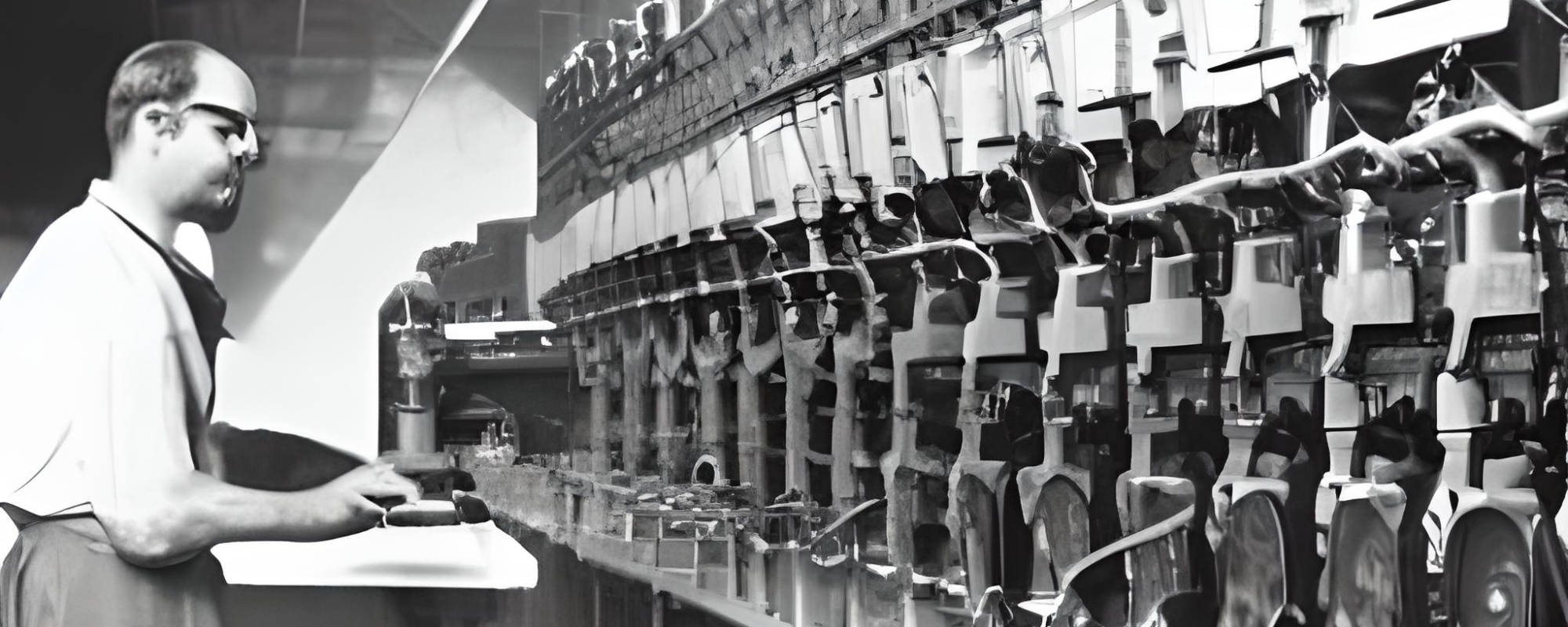
The development of automation has reduced the need for human intervention in production processes. It has reduced his role to planning activities, supervising equipment or capturing results in reports. It has thus streamlined the delivery of goods and services and reduced the number of errors caused by the human factor. It ranges from a simple internal controller managing the evaporator to modern systems with a large number of variables and information estimates.
The word “automation” was first used in the 1940s by Del Harder – a Ford employee. In this way, he described a specific type of mass and self-production of vehicles. However, the term should not be confused with automation, the discipline that deals with control.
Automation processes use many interrelated mechanical, electrical, pneumatic, electronic or PC devices. They create intricate structures that positively affect the quality and accuracy of the work performed. They reduce losses while optimizing energy costs, investments in new technology or material expenses.
Automation – how did it start?
Already in ancient times, people made every effort to improve their work. The ancient Greek word “automatia” means “that which moves by itself.” Ktesibios of Alexandria is considered one of the pioneers of ancient automation. In the 3rd century BC, he built a flow regulator whose mechanism was based on producing constant pressure and speed of water. Heron of Alexandria was also famous for his inventions. He constructed a device that automatically opened the doors to one of the temples, called “Mechanicus.” Their operation was powered by steam. One side of the axes on which the door was mounted was wrapped with ropes with weights, while a large bucket of water was attached to the other. Those praying were unaware that they were marveling at the power of human reason, not divine intervention.
The history of automation also includes ancient China. It turns out that it is from the Middle Kingdom that the differential used in automobiles originated. Ancient engineers constructed a chariot-like carriage. The figure standing on it always pointed south. How was this possible? The figure was connected to the wheels by a special gear. The mechanism of this invention was not discovered until the 1960s.
Although it is hard to believe, androids existed as early as the 13th century. They were mechanical automatons in animal or human form that imitated the movements of living beings. The English scientist Roger Bacon and St. Albert the Great, Bishop of Regensburg, are credited as their creators. According to records, they constructed an iron doorkeeper whose job was to greet visitors and open and close doors.
Development of science and technical thought during the Renaissance
The most famous representative of the Renaissance is undoubtedly the legendary Leonardo da Vinci – a multi-talented engineer and artist. With his genius he was ahead of the era, designing innovative machines and devices. He created an automatic weaving loom, a water-powered alarm clock or a kind of car based on a spring mechanism. He perfected the self-repeating catapult, and developed a centrifugal pump and ball bearings. Most of the models (multi-barrel guns, clockwork mechanism, helicopter) are preserved only in the form of sketches. Some constructions could not be built due to lack of access to suitable materials or sufficient knowledge.
Modern times, or the dynamic development of automation
The year 1745 belonged to Edmund Lee. He developed a mechanism by which windmills turned independently, and manual adjustment of the wings in the direction of the wind was no longer necessary. The “wind rose” was responsible for automatic adjustment. An equally epoch-making invention was the Power Loom, the first steam-powered weaving machine. The work by Edmund Cartwright revolutionized industrial production and made it possible to manufacture entirely new products.
Development of automation in the 1920s
Automation of industry on a huge scale took place in the United States after World War I. Innovations were seen primarily in chemical technology and the way electricity was transmitted. The first automated production line began its operation in 1923. The achievement on a global scale was the result of numerous discoveries in the fields of electrical voltage and pressure, as well as increasing knowledge of how to combine meters of physical and mechanical quantities with regulation and control devices.